Lifecycle planning guide
How to prevent surprise network renewals and replacement deadlines
Network renewals should be planned business events, not surprise invoices. A practical lifecycle view connects licenses, support, hardware condition, dependencies, budgets, and deployment lead time while there is still room to make a considered decision.
Guide in brief
- Record what each license or support term controls and what changes at expiration.
- Review renewal and hardware replacement timing together.
- Group decisions across locations while preserving site-specific requirements.
Campaign video
Do not let a renewal deadline choose for you
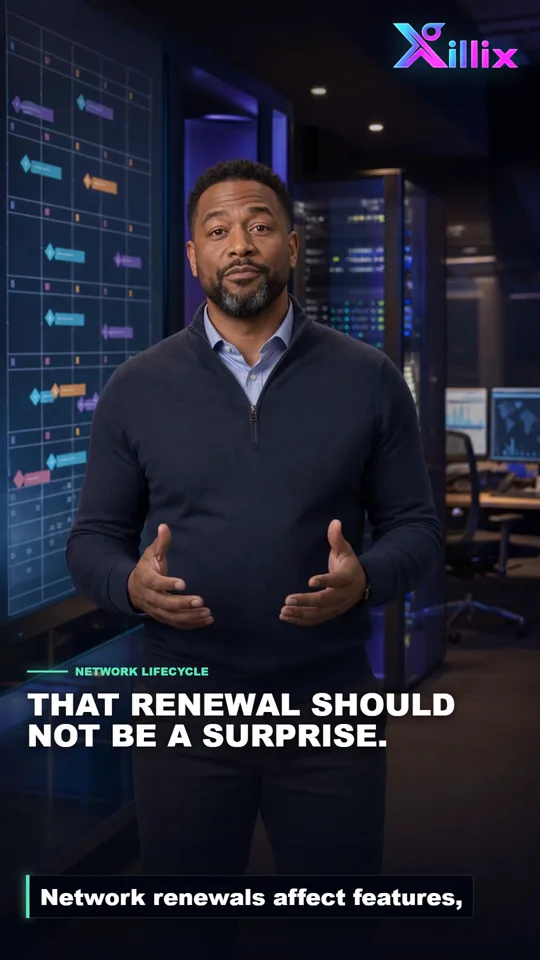
A 25-second Xillix campaign about making network licensing and replacement decisions before the deadline becomes urgent.
Visibility
Understand what the renewal controls
Lifecycle information is often fragmented. Purchase records may live in accounting, device details in a management dashboard, support terms with a supplier, and replacement decisions in a spreadsheet. Without one coordinated view, a business may not see how those records affect one another.
A network license may affect cloud management, security services, software access, technical support, hardware replacement, analytics, or other operating features. The effect varies by product and agreement. Record the product, serial number, site, license type, term, start and renewal dates, support coverage, dependencies, and decision owner.
- What equipment, subscriptions, support terms, and warranties are currently active?
- Where is each item installed and which business workflows depend on it?
- What changes at renewal or expiration, and who owns the decision?
- Which quote, approval, shipping, staging, and deployment steps must happen first?
Decision window
Connect licensing to hardware replacement planning
Renewal planning and replacement planning belong together. A long renewal for equipment approaching the end of useful support may not fit the business plan. Replacing equipment without accounting for existing terms can create overlap, gaps, or avoidable rush work.
A useful lifecycle review compares renewal dates with warranty status, support milestones, recurring incidents, capacity, security requirements, business expansion, budget cycles, equipment availability, and deployment lead time. That creates a decision window before the due date becomes the only fact driving the outcome.
Renew
Confirm the current platform still fits the requirement and document the new term, cost, coverage, and next decision date.
Replace
Allow time for requirements, quotes, approvals, availability, staging, installation, validation, and handoff.
Standardize
Group decisions where a repeatable pattern helps, while validating each site's users, devices, space, connectivity, and operations.
Lifecycle record
Build a view the business can maintain
The lifecycle record does not need to be complicated. It should answer what equipment and licenses exist, where they are installed, which features depend on each term, when decisions are due, and which products are approaching replacement or support milestones.
Review the record on a regular schedule and assign owners for renewal and replacement decisions. Keep relevant quotes, diagrams, configuration records, warranties, acceptance documents, and exceptions connected to the asset record so planning begins with current evidence.
Frequently asked questions
What belongs in a network lifecycle record?
Include equipment, location, serial or asset identifier, license and support terms, dates, dependencies, warranty, owner, replacement status, and the records needed for the next decision.
How early should a network renewal be reviewed?
Begin early enough to gather requirements, compare options, obtain approval, handle lead times, stage equipment, and schedule deployment if replacement is a realistic option.
Should multi-location renewals be grouped?
Grouping can simplify budgeting and standards, but each site still needs validation for its users, devices, space, circuits, dependencies, and operating requirements.
Continue exploring
Related Xillix resources
Use these guides and product pages to compare the next practical step.
Network licensing and renewals
Review how lifecycle records support renewal, replacement, budgeting, and deployment decisions.
Explore lifecycle planningEquipment and licensing
Prepare complete equipment and licensing requirements for written quotes.
Review equipment and licensingBusiness network refresh
Plan a phased refresh around risk, dependencies, maintenance, testing, and documentation.
Plan a network refreshMake the decision before the deadline makes it for you.
Share current equipment, locations, renewal dates, known dependencies, support status, and planned business changes for a focused lifecycle review.
Request a Network Review